Why Winston-Salem Summer Storms Are Tough on Retaining Walls
Winston-Salem summers are famous for heat and humidity, but the real threat to your retaining wall arrives in sudden, intense thunderstorms. A single afternoon storm can drop an inch or more of rain in less than an hour. When that water falls on a slope above a wall, it has to go somewhere. If the wall was built without a proper drainage system, that water soaks into the backfill soil and stays there, pressing against the wall from behind.
This is not a rare scenario in Winston-Salem. The region's clay-heavy soils absorb water slowly and hold it for days. After a storm, the soil behind your wall can remain saturated long after the surface looks dry. That stored moisture creates continuous pressure, and over time it can push a wall out of alignment, crack concrete, or cause a total collapse. Understanding this cycle is the first step toward protecting your investment.
Hydrostatic Pressure: The Silent Force Behind Wall Failure
Hydrostatic pressure is the force exerted by water when it is trapped and cannot flow away. In a retaining wall, saturated backfill soil acts like a heavy, slow-moving liquid. The water fills every pore space in the soil and pushes outward in all directions, including directly against the back of your wall. Most retaining walls are designed to hold back soil, not to act as a dam. When hydrostatic pressure builds, the wall is asked to do a job it was never engineered for.
The results show up in predictable ways. You may notice horizontal cracks in a concrete wall, bulging or leaning sections, or soil washing out from around the base. In severe cases, the wall can fail suddenly after a heavy storm. The tricky part is that the damage often starts long before you see it. By the time a crack appears, the drainage problem has usually been building for months or years. This is why Retaining Wall Repair often begins with diagnosing water management, not just patching the visible damage.
The Role of a Retaining Wall French Drain
A retaining wall french drain is the most reliable way to relieve hydrostatic pressure. It typically consists of a perforated pipe placed in a gravel-filled trench along the base of the wall, wrapped in filter fabric to keep soil out. Water enters the pipe through the perforations and flows by gravity to a safe discharge point, such as a daylight outlet or a storm drain. Gravel around the pipe creates a fast path for water, while the fabric prevents fine particles from clogging the system.
Just as important is the backfill material. Well-draining gravel placed directly behind the wall allows water to move down to the drain instead of sitting against the wall face. Some systems also include a drainage board or geocomposite layer against the wall to keep soil from pressing directly on it. When these components work together, water leaves the wall zone quickly after a storm, and hydrostatic pressure never has a chance to build. If you are planning new Retaining Wall Installation, insist that a french drain and proper backfill are part of the plan from day one.
Warning Signs Your Retaining Wall Drainage Is Failing
Homeowners in Kernersville and Clemmons face the same soil and storm conditions as Winston-Salem, and the warning signs are similar. Look for water pooling at the base of the wall after rain, soggy soil behind the wall, or a white chalky stain on concrete (efflorescence) that suggests water is moving through the wall. Weep holes that stay dry during a storm are another red flag: they may be clogged, or the drain behind them may have failed.
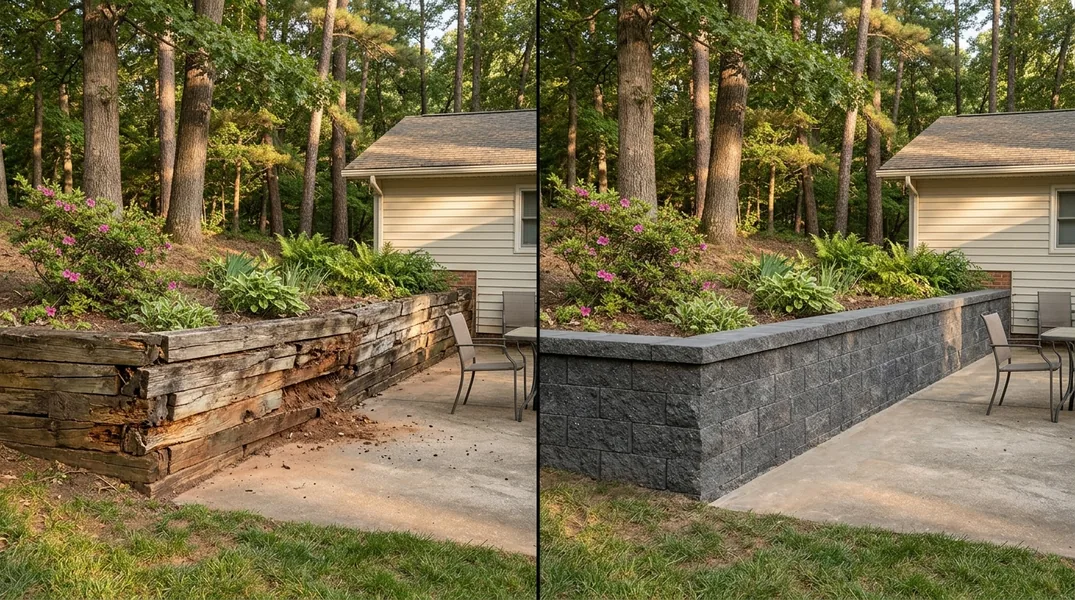
Structural clues matter too. A wall that leans slightly more each season, cracks that widen over time, or soil settling in a depression behind the wall all point to drainage problems. Small issues are far cheaper to fix than a collapsed wall. A professional inspection can confirm whether your drain is working or whether the system needs to be rebuilt. For walls that are already severely damaged, Retaining Wall Replacement may be the safer and more cost-effective path than repeated repairs.
Retaining Wall Drainage Near Me: When to Call a Professional
If you are searching for retaining wall drainage help near me, the best time to call is before the next big storm, not after. A qualified installer can evaluate the slope, soil type, and existing wall condition, then recommend a drainage solution that fits your property. In many cases, retrofitting a french drain and correcting the backfill can extend the life of a wall that is still structurally sound. In others, partial rebuilding or a switch to Concrete Retaining Walls with integrated drainage makes more sense.
Do not wait for visible failure. Summer downpours in the Piedmont are intense, and a wall that survived last year may be one storm away from serious damage. A professional assessment is quick and can save you thousands in emergency repairs. If you are unsure whether your wall needs attention, reach out for a free estimate and get a clear answer before the next round of storms arrives.
Protecting Your Investment: Drainage First, Everything Else Second
The most important lesson about retaining walls is simple: water is the enemy, and drainage is the defense. A wall built with excellent materials but poor drainage will fail faster than a modest wall with a well-designed french drain. As you plan repairs or new construction, prioritize the drainage system, the gravel backfill, and the outlet. These are not optional upgrades. They are the core of a wall that lasts through decades of Winston-Salem weather.
Budgeting for drainage upfront is far less expensive than fixing a collapsed wall later. If you would like to understand typical project pricing, the team at Winston-Salem Retaining Wall can walk you through options for your property. Call (743) 210-3267 to schedule an assessment and make sure your wall is ready for the next summer downpour.
Looking for a professional retaining wall contractor in Winston-Salem? Winston-Salem Retaining Wall responds fast for all your retaining wall needs.
Get a Free QuoteOur services: Retaining Wall Installation · Retaining Wall Repair · Retaining Wall Replacement